WORKSHEETS
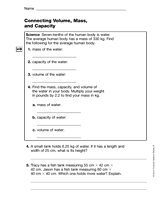
Your students will use the information provided to answer questions about the volume, mass, and capacity of the human…
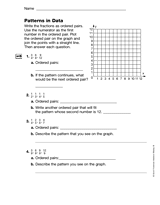
Students order fractions, plot the data on a graph, and then answer questions.
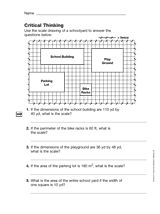
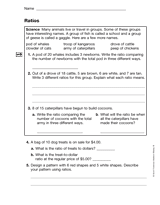
Students employ critical thinking skills to solve ratio, percent, and probability math problems.
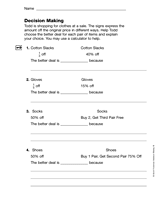
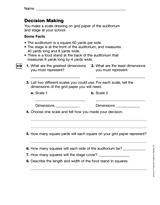
Students employ decision making skills to solve math problems.
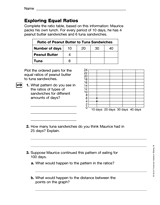
Students explore ratios as they solve these word problems.
Students identify the ratio pattern, then complete each table.
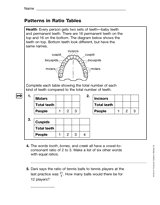
Students use the information provided to complete each ratio table.
Students make a scale drawing on grid paper of their school's auditorium and stage, and then answer questions.
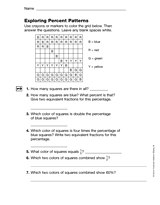
Students explore percent patterns by coloring a grid and answering questions.
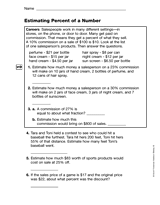
Students estimate the percent of a number to solve story problems.
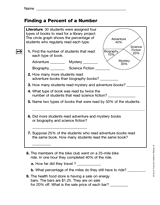
Students use the percentages in a circle graph to answer questions.
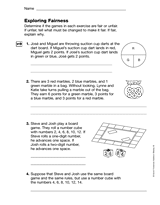
Students determine if the game in each exercise is fair or unfair.
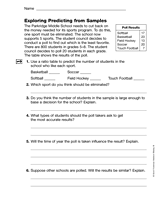
Students use a ratio table to answer questions about prediction.
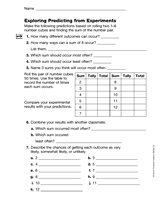
Students make predictions based on the results of their experiment.
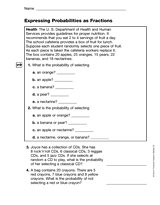
Students determine the probability for each situation, and express the answer as a fraction.
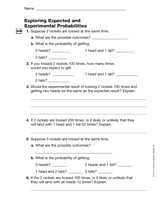
Students explore the expected and experimental answers to probability problems.
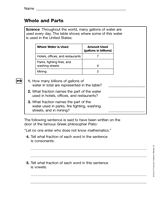
Students use the information provided to determine fractions and solve problems.
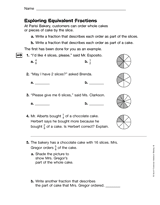
Students identify and compare fractions with equivalent values.
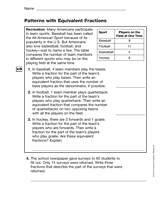
Students solve word problems by identifying equivalent fractions and patterns.
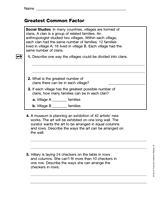
Students evaluate information to determine the greatest common factor for solving each problem.
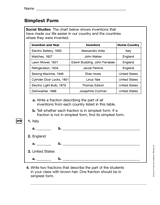
Students create fractions and rewrite them in their simplest form.
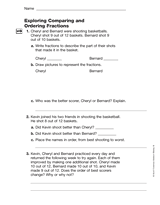
Students create fractions and order them to solve story problems.
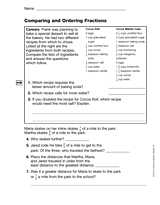
Use this printable worksheet to help your students learn to compare fractions to answer questions. Students will have…
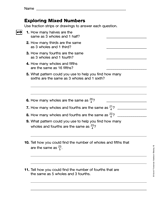
Students use fraction strips to review whole numbers, fractions, and mixed numbers. This printable worksheet is an…