WORKSHEETS
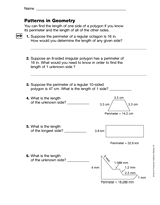
Students employ algebra and geometry skills to find and continue patterns.
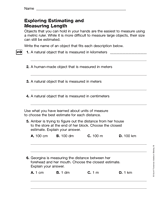
Students measure smaller objects and estimate measurements for larger objects.
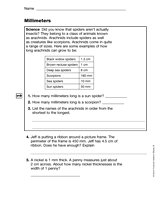
Students use the information in a chart to answer questions.
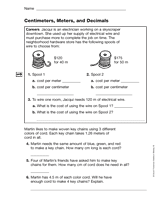
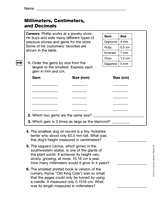
Students use decimals to compare centimeters and meters.
Students use decimals to compare millimeters and meters.
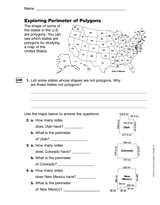
Students us a map of the U.S. to explore polygons and their perimeters.
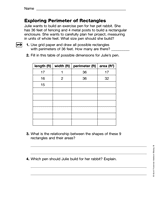
Students use the table and information provided to find rectangle dimensions.
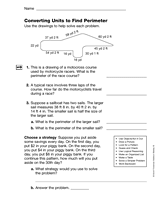
Students use drawings to solve problems.
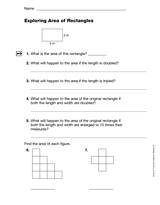
Students explore the logic behind finding the area of rectangles.
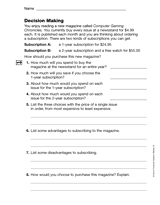
Students employ decision making skills to solve math story problems.
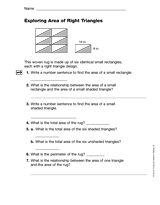
Students answer questions and use a diagram to explore the area of right triangles.
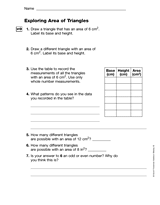
Students fill in a chart and draw triangles to answer questions about area.
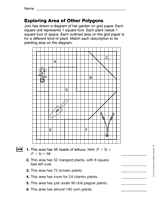
Students use a grid and a diagram to answer questions about the area of polygons.
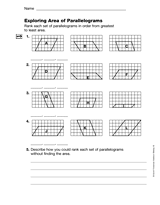
Students find the area of parallelograms, and then put them in order.
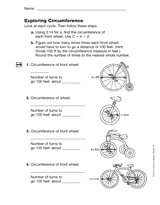
Students follow instructions to find the circumference of each illustrated wheel.
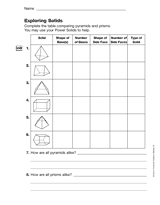
Students compare different solids, including cubes, pyramids, and rectangular prisms, by the number of faces, the shape…
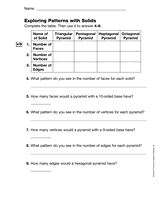
Students complete a table with information about pyramids, and answer questions.
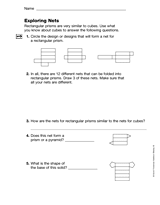
Students use their knowledge of cubes to answer questions about rectangular prisms.
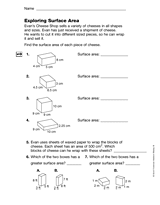
Use this activity to have your students find the surface area of rectangular prisms to solve problems. The worksheet…
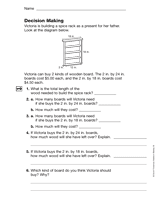
Students use decision making skills to solve story problems involving measurements.
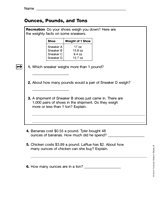
Students use the weights provided to solve story problems.
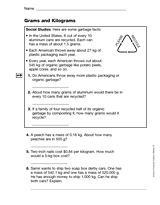
Students answer story problems involving grams and kilograms.
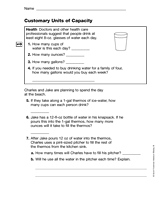
In this worksheet, your students convert fluid ounces, cups, and gallons to solve story problems. Visual representations…
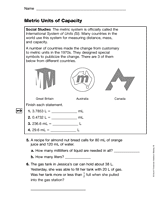
Your students will learn about the history of the metric system and convert metric units of volume to solve problems, in…